
The vast majority of production lines only pass a “single-criteria evaluation.” Currently, glove selection and acceptance at many factories commonly suffer from a trade-off—while seemingly compliant with standards, they actually harbor hidden dual risks, which are the core causes of yield rate fluctuations and frequent hand-related issues among employees.
Focusing solely on personal protection while neglecting product cleanliness often leads to the selection of ordinary latex or standard nitrile gloves—prioritizing soft texture, comfortable fit, and low cost—which only meet basic employee needs such as comfort, scratch resistance, and protection against contact contamination. However, most of these gloves suffer from high levels of additive residue, excessive particle shedding, excessive ionic leaching, and silicone oil lubrication. While no immediate health issues may be apparent, they continuously cause hidden defects such as micro-stains, rainbow marks, oxidation and corrosion, and parameter drift, which over the long term lower mass production yield rates and create potential risks for customer complaints.
Focusing solely on product cleanliness while neglecting employee comfort: Some high-end production lines excessively pursue high cleanliness and low leaching, blindly selecting stiff, high-additive, and poorly fitting industrial-grade gloves. While these gloves meet the requirements for dust-free and contamination-free products, they neglect the long-term wearing experience of employees. Prolonged use can lead to stuffy hands, peeling skin, itching, and chronic contact dermatitis. This not only reduces work efficiency but also accumulates occupational health risks, increasing staff turnover and labor-related issues.
Core Conclusion: Personnel protection compliance ≠ product process compliance; product cleanliness compliance ≠ personnel fit compliance. In high-end precision manufacturing, a dual-assessment closed-loop system must be established.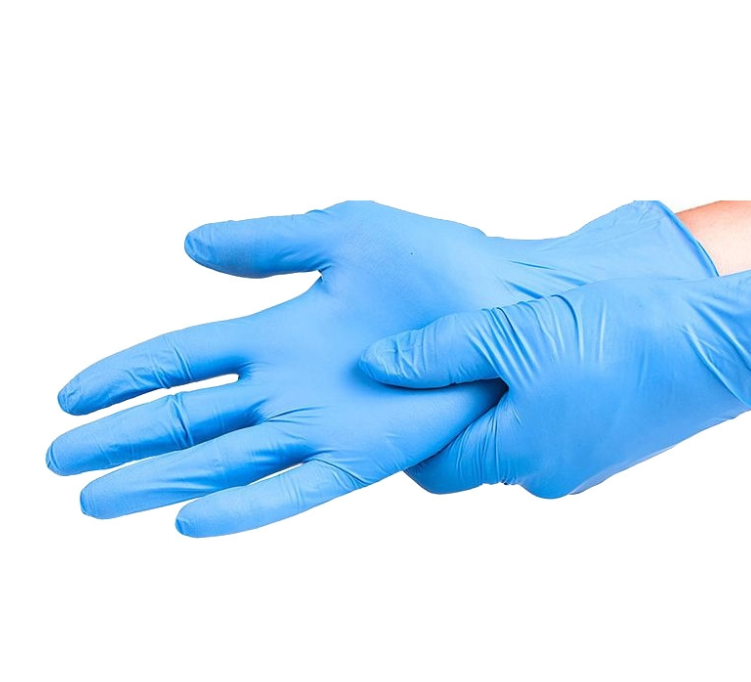
First Assessment: Health Protection Standards for Workers The core of worker protection assessment is to prevent acute allergies, chronic irritation, and long-term occupational injuries, while ensuring suitability for high-frequency, prolonged wear on assembly lines. The core assessment metrics are clear and actionable.
Allergen Control (Core Mandatory Metric) Natural latex gloves contain latex proteins, which can easily trigger immediate allergic reactions such as redness, swelling, and itching; Conventional nitrile gloves contain excessive residues of chemical additives such as vulcanizing accelerators and stabilizers, which cause more than 80% of cases of chronic delayed-onset dermatitis, as well as dry, cracked, and peeling skin on the hands. Compliant gloves must strictly control these dual allergens through low-protein formulations and minimal additive residues, thereby reducing the risk of skin irritation at the source.
Wearing Comfort and Fit: A snug, flexible fit that is supple without being tight, as well as resistance to bending and tearing, constitutes the baseline for basic protection. Gloves that are too stiff or tight restrict hand dexterity while exacerbating heat buildup and hand fatigue; gloves prone to tearing directly compromise protection, failing to block contaminants, cleaning agents, and contact irritants, and thus fail to meet basic personal protection requirements.
Powder-free and free from external irritants: The powder particles in traditional powdered gloves absorb sweat and impurities, irritating the skin and causing inflammation; at the same time, the spread of powder can cause secondary contamination in the workshop. Compliant, high-grade gloves must be lubricated and completely powder-free throughout the entire process to eliminate the dual risks to both personnel and equipment posed by powder.
Second Evaluation Criteria: Process Cleanliness Standards for Product Yield The core of product yield evaluation lies in zero microscopic contamination, low leaching, and high stability—eliminating random and hidden process defects caused by glove materials or manufacturing residues. This is the fundamental distinction between high-end and ordinary consumables.
Particle Control: Eliminating Defects Caused by Flaking and Foreign Matter Most production line defects—such as irregular white spots, foreign matter, and poor adhesion—stem from loose adhesive particles and residual dust on the glove’s surface. Gloves treated with deep purification via dual-chlorine washing and multi-stage ultrapure water rinsing feature a compact and dense surface structure, which significantly reduces LPC particle release. This eliminates product contamination caused by friction-induced flaking at the source, making them suitable for Class 100 and Class 1,000 high-cleanliness workstations.
Leaching Control: Eliminating Hidden Chemical Defects—This is the most easily overlooked factor affecting yield. Residual silicone oil, NVR (non-volatile residues), and sulfur/chlorine ion residues in ordinary gloves can cause haze and rainbow patterns in optical products, oxidation of metal plating, parameter drift in semiconductor devices, and micro-corrosion of circuits. High-performance compliant gloves must meet standards for no added silicone oil, low sulfur and chlorine content, and low ionic leaching, making them suitable for highly sensitive processes such as precision electronics, optics, and third-generation semiconductors.
Post time: Sep-04-2026