
Cleanroom cleaning requires more than removing visible dust and dirt. In semiconductor manufacturing, electronics assembly, optical production and other precision industries, even microscopic particles, fibers or chemical residues can affect product quality and manufacturing processes.
This is why microfiber wipes have become an important option for cleanroom cleaning. Made with extremely fine synthetic fibers, they offer several advantages, including effective particle pickup, good liquid absorption, gentle surface contact and versatile cleaning performance.
For cleanroom consumables distributors, understanding these benefits helps explain why microfiber wipes are selected for specific applications and how they differ from conventional polyester cleanroom wipes.
However, microfiber is not automatically the best choice for every cleanroom. Its performance depends on fiber construction, manufacturing processes, washing, edge finishing and the cleanliness requirements of the application.
This article explores the main benefits of microfiber wipes and explains what buyers should consider when selecting them.
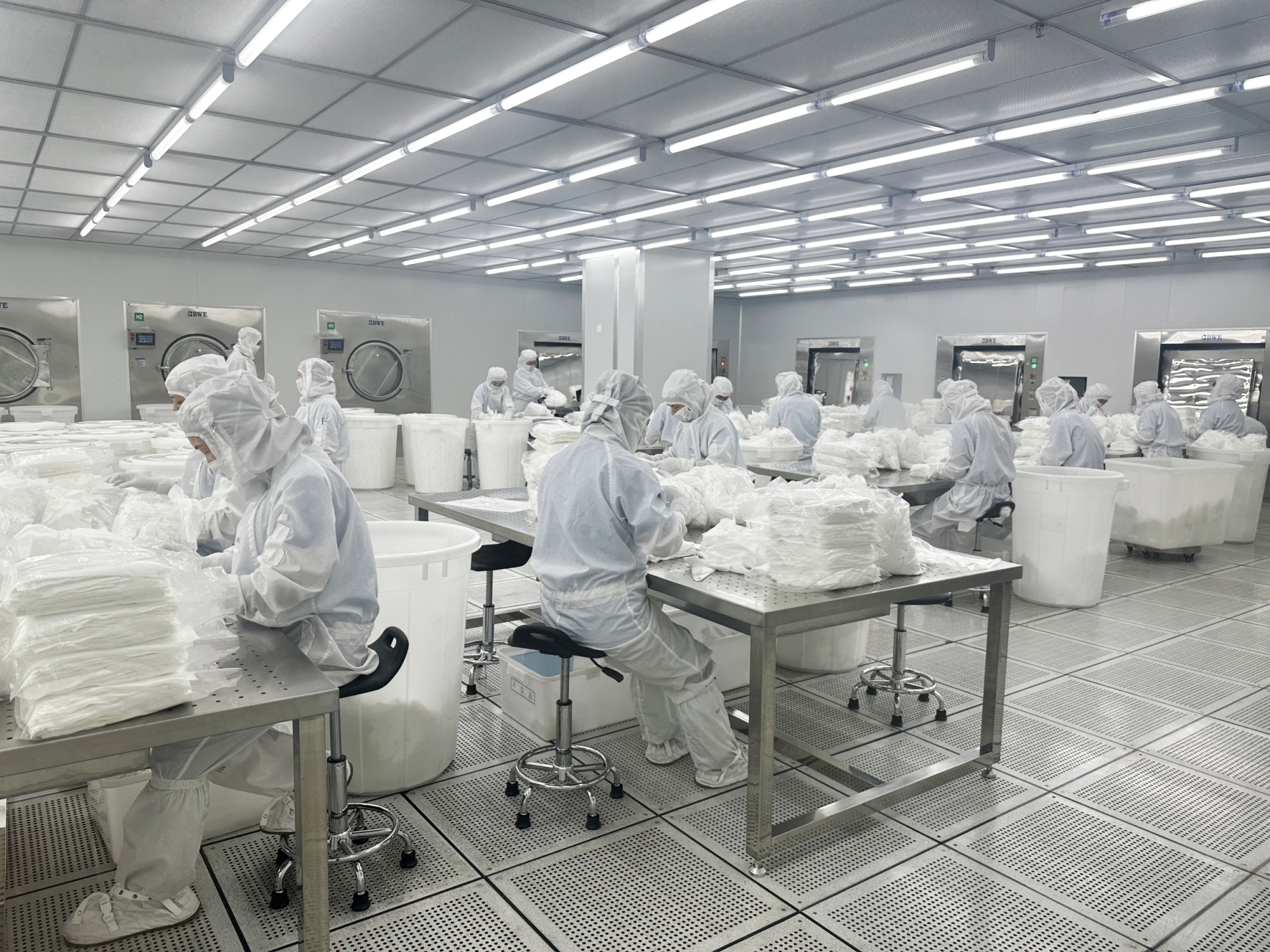
1. Better Particle and Residue Removal
One of the main advantages of microfiber wipes is their ability to capture and remove fine particles and surface residues.
Microfiber uses very fine filaments that create a large effective contact area. Depending on the fiber structure, these fine fibers can reach surface irregularities and help pick up contaminants that ordinary wiping materials may leave behind.
This makes microfiber wipes useful for cleaning:
- Semiconductor equipment surfaces
- Optical components and glass
- Precision electronic assemblies
- Display manufacturing equipment
- Stainless steel work surfaces
- Other contamination-sensitive surfaces
When used with an appropriate wiping technique, microfiber can help capture particles and transfer them away from the cleaned surface.
The important distinction is between removing contamination and simply moving it around. A suitable wipe should retain the collected contaminants rather than release them back onto the surface.
For this reason, buyers should evaluate both particle-removal performance and the wipe’s own particle and fiber release.
2. High Liquid Absorption Capacity
Another important benefit of microfiber wipes is their liquid absorption performance.
The fine fiber structure creates numerous spaces between fibers, allowing the material to absorb and retain liquids.
Compared with conventional polyester knitted wipes, certain microfiber constructions can offer greater liquid absorption.
This is particularly useful when cleaning processes involve:
- Deionized water
- Isopropyl alcohol (IPA)
- Approved cleaning solvents
- Liquid residues on equipment surfaces
- Precision surface wiping
Good absorbency helps reduce the amount of liquid remaining on a surface after cleaning.
However, absorption capacity and absorption speed are different measurements. Buyers should consider both when evaluating a product.
Two useful indicators are:
| Parameter | What It Measures |
|---|---|
| Intrinsic absorbency | Liquid absorbed relative to the weight of the wipe, commonly ml/g |
| Extrinsic absorbency | Liquid absorbed relative to the wipe’s surface area, commonly ml/m² |
| Absorption rate | How quickly the wipe absorbs a specified liquid |
For distributors, requesting actual absorbency data is more useful than relying on general descriptions such as “super absorbent.”
3. Gentle Cleaning for Sensitive Surfaces
Microfiber wipes are often selected for applications involving delicate or scratch-sensitive surfaces.
Their fine and soft fiber structure can provide gentle contact during wiping, making them suitable for certain optical and precision cleaning tasks.
Typical applications include:
- Optical lenses
- Display panels
- Precision glass
- Polished metal surfaces
- Sensitive equipment components
Compared with some conventional wiping materials, appropriately designed microfiber products can reduce the risk of unwanted surface abrasion.
This does not mean every microfiber wipe is automatically scratch-free. Surface damage can also depend on trapped particles, wiping pressure, surface coatings and the condition of the wipe.
For high-value optical or display applications, buyers should conduct sample testing on representative surfaces before approving a product for regular use.
4. Effective Cleaning with Dry and Wet Wiping
Microfiber wipes can be used in both dry and wet cleaning processes, depending on their construction and compatibility with the intended cleaning agents.
Dry wiping
Dry microfiber wipes can help remove loose particles, fingerprints and surface residues from suitable surfaces.
They are useful for routine cleaning where additional liquid is not required.
Wet wiping
When used with a compatible cleaning solution, microfiber wipes can help loosen and capture surface contamination while absorbing excess liquid.
Wet wiping can also improve particle retention during cleaning because moisture helps keep collected particles attached to the wipe.
For applications involving IPA or other solvents, confirm the chemical compatibility of the wipe before use.
Pre-saturated microfiber wipes are another option for applications requiring consistent liquid distribution and controlled solvent usage.
5. Good Durability for Repeated Wiping Operations
Microfiber wipes made from synthetic fibers can offer good mechanical strength and durability when properly manufactured.
Their durability is influenced by:
- Polyester and nylon composition
- Fiber construction
- Fabric density
- Edge-finishing method
- Washing and processing quality
A durable wipe can maintain its structure during normal wiping operations and reduce the likelihood of premature fabric breakdown.
However, durability does not automatically mean that a cleanroom wipe can be reused.
Reuse depends on the product design, cleaning process, contamination level and the customer’s validated procedures. For critical cleanroom applications, disposable use may be required.
Buyers should follow the manufacturer’s instructions and their own contamination-control requirements.
6. Versatility Across Different Cleanroom Industries
Microfiber wipes are used across several industries because their combination of fine fiber structure, absorbency and surface-cleaning characteristics can suit different cleaning requirements.
<text weight=”semibold”>Semiconductor Manufacturing</text>
Used for selected equipment surfaces and precision components where particle pickup and contamination control are important.
<text weight=”semibold”>Electronics Manufacturing</text>
Can be used to remove fingerprints, dust and surface residues from suitable electronic components and production equipment.
<text weight=”semibold”>Optical and Display Industries</text>
Suitable microfiber configurations can help clean delicate glass, lenses and display-related surfaces.
<text weight=”semibold”>Laboratories and Precision Manufacturing</text>
Can support routine equipment and surface cleaning where absorbency and controlled wiping are required.
The appropriate wipe grade should always be determined by the specific application, surface material and cleanliness requirements.
7. Potentially Better Cleaning Efficiency
Microfiber wipes can combine particle pickup, liquid absorption and surface cleaning in one product.
This combination may help reduce the need for multiple wiping materials during certain cleaning procedures.
For example, a suitable microfiber wipe may be used to:
- Remove loose surface particles
- Pick up fingerprints and residues
- Absorb cleaning solutions
- Wipe away excess liquid
- Clean selected precision surfaces
Using one suitable product for several related tasks can simplify inventory management for distributors and end users.
However, cleaning efficiency should be evaluated under actual working conditions. The result depends on the contaminant, cleaning solution, wiping method and surface being cleaned.
8. Microfiber Wipes vs. Conventional Polyester Cleanroom Wipes
Both microfiber and conventional polyester wipes are widely used in cleanroom environments. They have different characteristics and should be selected according to application requirements.
| Comparison | Microfiber Wipes | Conventional Polyester Wipes |
|---|---|---|
| Fiber structure | Very fine fibers | Standard polyester filaments |
| Particle pickup | Often effective for fine particles and residues | Depends on fabric construction |
| Liquid absorption | Often higher for suitable microfiber constructions | Generally lower than comparable microfiber products |
| Surface softness | Generally soft and suitable for selected delicate surfaces | Depends on knit structure and finishing |
| Durability | Depends on fiber construction and processing | Often offers good mechanical durability |
| Particle release | Must be evaluated by product; some microfiber products may release more particles or fibers | High-quality laundered polyester wipes can offer very low particle release |
| Typical consideration | Cleaning performance and absorbency | Low contamination and controlled wiping |
There is no universal winner.
For applications where liquid absorption and removal of fine surface residues are priorities, microfiber may be a suitable option.
For applications requiring particularly low particle and fiber release, a high-quality laundered polyester wipe may be more appropriate.
The decision should be based on product-specific test data rather than material names alone.
9. What Should Buyers Check Before Selecting Microfiber Wipes?
Although microfiber wipes offer several advantages, buyers should evaluate the finished product carefully.
The following specifications are particularly important.
Material Composition
Common microfiber constructions include polyester and nylon blends, such as 80/20 or 75/25. Confirm the actual composition with the supplier.
Fabric Weight (GSM)
GSM indicates the fabric’s basis weight. Different weights influence thickness, handling and absorbency characteristics.
Edge Finishing
Laser sealing, ultrasonic sealing and other edge-processing methods may be available. The selected method should be supported by suitable particle and fiber release data.
Particle and Fiber Release
Request test results for the exact product, including the relevant test method and particle size range.
Non-Volatile Residue (NVR)
NVR data helps buyers understand the level of extractable non-volatile substances that may remain after the wipe contacts a surface.
Ionic Contamination
For semiconductor and electronics applications, ask whether sodium, potassium, chloride and other relevant ions have been tested.
Packaging and Processing
Confirm washing arrangements, cleanroom packaging, bag materials and whether double-bagged packaging is available.
A cleanroom wipe’s performance depends on the complete manufacturing and packaging process, not simply its raw material.
10. How Honbest Supports Microfiber Wipe Sourcing
Honbest Group supplies cleanroom and ESD consumables to overseas distributors and industrial customers.
Its product portfolio includes microfiber wipers, polyester cleanroom wipes, cleanroom paper, gloves, sticky products and ESD-related consumables.
With nearly 20 years of involvement in the cleanroom wiper industry, Honbest understands the product specifications and sourcing considerations that distributors commonly encounter.
For microfiber wipe projects, buyers can discuss:
- Available microfiber product configurations
- Material composition and fabric specifications
- Wipe dimensions and edge-finishing requirements
- Sample evaluation
- Packaging and private-label requirements
- Other cleanroom consumables for consolidated sourcing
Specific product specifications, test reports and customization options should be confirmed for each project.
Explore the Honbest Microfiber Wiper product range or visit the Honbest product catalog to learn more about its cleanroom and ESD consumables.
Frequently Asked Questions
Q1: What is the main benefit of microfiber wipes in cleanrooms?
One of their main advantages is the combination of fine-particle and residue pickup with good liquid absorption. This makes them useful for selected precision cleaning applications.
Q2: Are microfiber wipes better than polyester cleanroom wipes?
Not in every situation. Microfiber often offers better absorbency and effective surface cleaning, while high-quality laundered polyester wipes may provide lower particle and fiber release. The right choice depends on the application.
Q3: Can microfiber wipes be used in semiconductor cleanrooms?
Yes, certain microfiber wipes are designed for semiconductor and other contamination-sensitive applications. Buyers should confirm the product’s particle release, fiber release, ionic contamination and NVR data against their process requirements.
Q4: Are microfiber wipes suitable for optical cleaning?
Certain microfiber configurations are suitable for delicate optical surfaces because of their fine fiber structure and softness. Sample testing is recommended to verify surface compatibility.
Q5: Can microfiber wipes be used with IPA?
Some microfiber wipes are compatible with IPA, but compatibility depends on the material and manufacturing process. Confirm the supplier’s chemical compatibility information before use.
Q6: Do microfiber wipes release particles?
Yes. Every wiping material can contain or release some particles and fibers. Microfiber products should be evaluated using appropriate particle and fiber release tests. Very fine fibers do not automatically guarantee lower contamination.
Q7: Are microfiber wipes reusable?
Some products may tolerate limited reuse, but this depends on their construction and the cleaning process. For critical cleanroom applications, follow the manufacturer’s instructions and the customer’s validated procedures.
Conclusion
Microfiber wipes offer several advantages for cleanroom cleaning, including effective particle pickup, good liquid absorption, gentle surface contact and versatility across different precision manufacturing applications.
These characteristics make them a valuable option for semiconductor, electronics, optical and laboratory cleaning processes.
However, choosing the right microfiber wipe requires more than looking at its material composition or absorbency. Particle release, fiber shedding, NVR, ionic contamination, edge finishing and packaging should all be considered.
For cleanroom consumables distributors, understanding these differences helps match the right wiping product to each customer’s requirements and build a more reliable product portfolio.
Honbest provides microfiber wipers alongside a wider range of cleanroom and ESD consumables, supporting distributors looking for a broader sourcing solution.
Post time: Nov-20-2026