
For distributors of cleanroom consumables, offering polyester wipes under a private label can be a practical way to expand product lines and strengthen customer relationships. However, OEM sourcing involves more than printing a logo on a package. Wipe material, fabric weight, dimensions, edge finishing, cleanliness requirements and packaging all influence the final product.
China is an important sourcing destination for polyester cleanroom wipes, with suppliers offering different product configurations and customization options. The key is to find a supplier that can understand your technical requirements, coordinate the right manufacturing process and maintain consistency between samples and bulk orders.
This guide explains the main customization options, how to evaluate an OEM supplier and what distributors should prepare before requesting a quotation.

1. Why Distributors Choose OEM Polyester Cleanroom Wipes
Polyester cleanroom wipes are widely used in electronics manufacturing, semiconductor-related production, optical applications and other controlled environments.
They are commonly selected for their durability, low-lint characteristics and suitability for precision surface wiping. Their actual performance depends on fabric construction, finishing methods and manufacturing controls.
For distributors, OEM sourcing offers several commercial advantages:
- Brand development: Sell products under your own brand instead of relying entirely on generic products.
- Product differentiation: Specify dimensions, fabric weight and edge finishing to match your target market.
- Flexible packaging: Adapt bag labels, carton markings and pack quantities to your distribution requirements.
- Product portfolio expansion: Add different polyester wipe grades for customers with different cleaning requirements.
- Long-term supply planning: Establish consistent product specifications for repeat orders.
OEM customization is particularly useful for distributors serving semiconductor, electronics, optical and precision manufacturing customers.
2. What Can Be Customized in Polyester Cleanroom Wipes?
Before contacting an OEM supplier, distributors should understand the main technical parameters that define a polyester wipe.
2.1 Material and Fabric Construction
Polyester cleanroom wipes are commonly made from continuous-filament polyester fabric. Fabric construction and finishing influence softness, durability, particle release and wiping performance.
Common options include:
- 100% polyester knitted fabric
- Different fabric weights according to the required application
- Different fabric structures and surface characteristics
When comparing suppliers, avoid evaluating products by material name alone. Two products described as 100% polyester may perform differently because of differences in fabric construction, washing and finishing processes.
Ask suppliers to provide a Technical Data Sheet (TDS) and representative samples for evaluation.
2.2 Fabric Weight (GSM)
GSM refers to grams per square meter and indicates the fabric’s basis weight.
Common polyester cleanroom wipe options include:
| Fabric Weight | General Consideration |
|---|---|
| 110–120 GSM | A lighter fabric option for general wiping requirements |
| 140–150 GSM | A medium-weight option for applications requiring a balance of flexibility and durability |
| 160 GSM and above | A heavier option for customers who require a more substantial wipe |
These ranges are examples of commonly specified configurations, not universal performance grades. Actual availability and performance should be confirmed with the supplier.
For OEM orders, it is important to specify the required GSM and its acceptable tolerance rather than simply requesting a “standard polyester wipe.”
2.3 Wipe Dimensions
Standard sizes commonly requested by distributors include:
- 4 × 4 inches
- 6 × 6 inches
- 9 × 9 inches
- 12 × 12 inches
Custom dimensions may also be considered according to the available fabric width, cutting equipment and order quantity.
For example, 9 × 9-inch wipes are widely used in cleanroom and electronics-related applications, while smaller wipes may be suitable for cleaning compact components and precision instruments.
Distributors should confirm whether the requested dimensions refer to the finished wipe size and specify the acceptable dimensional tolerance.
2.4 Edge Finishing
Edge finishing is an important consideration because cut edges can contribute to fiber and particle release.
Common options include:
| Edge Type | General Characteristics |
|---|---|
| Cold Cut | Conventional cutting method, generally more economical |
| Laser Cut | Uses laser processing to seal the cut edge |
| Ultrasonic Cut | Uses ultrasonic energy to bond the edge area |
Laser-cut and ultrasonic-cut options are often considered for applications with more demanding contamination-control requirements.
However, an edge-finishing method alone does not establish a cleanroom classification. Buyers should evaluate the complete product, including particle and fiber release data, cleanliness controls and application suitability.
3. Private-Label Packaging for Polyester Wipes
For distributors, packaging is an important part of an OEM project. It affects brand presentation, product identification, storage and handling.
Depending on the supplier’s capabilities, packaging customization may include:
Inner bag printing
- Customer logo
- Brand name
- Product description
- Size and fabric weight
- Product code or item number
- Batch or lot identification
Pack quantity
Common configurations may include 100 or 150 wipes per bag, depending on the wipe size, fabric weight and packaging requirements.
Outer carton
- Private-label carton design
- Custom carton labels
- Product specifications
- Quantity and gross weight
- Shipping marks
Packaging materials
The appropriate packaging should protect the wipes from dust and moisture during storage and transportation. For products intended for cleanroom use, buyers should confirm the packaging structure and cleanliness requirements with the supplier.
Before mass production, approve the final artwork and packaging sample. This helps reduce errors in product descriptions, dimensions, logos and labeling.
4. Quality Requirements: What Should Distributors Check?
A professional OEM project should define quality requirements before production begins.
For polyester cleanroom wipes, distributors may consider the following parameters:
| Quality Parameter | What to Confirm |
|---|---|
| Material composition | Whether the wipe is made from 100% polyester |
| Fabric weight | Actual GSM and acceptable tolerance |
| Dimensions | Finished size and dimensional tolerance |
| Edge finishing | Cold cut, laser cut or ultrasonic cut |
| Particle release | Test method and available results |
| Fiber release | Test data where applicable |
| Absorbency | Relevant liquid absorption requirements |
| Ionic contamination | Applicable test results if required |
| Non-volatile residue | Relevant NVR data if required |
| Packaging | Bag material, pack quantity and sealing method |
Not every customer requires every test. Semiconductor and other contamination-sensitive applications may have more specific requirements than general industrial wiping applications.
Distributors should request relevant test reports rather than relying only on descriptions such as “lint-free,” “ultra-clean” or “Class 100.”
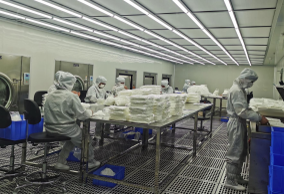
It is also important to distinguish between the cleanroom classification of the manufacturing environment and the verified performance of the finished wipe.
5. How to Select a Polyester Wipes OEM Supplier in China
A supplier’s ability to offer customization is only one part of the evaluation. Distributors should also consider technical communication, quality consistency and supply arrangements.
Check Product Experience
Ask whether the supplier has experience with polyester cleanroom wipes rather than only general-purpose industrial wipes.
Relevant experience includes understanding fabric construction, edge processing, cleanroom packaging and contamination-control requirements.
Review Samples Before Bulk Orders
Samples allow your technical team or customers to evaluate the actual product.
A useful sample evaluation may include:
- Fabric feel and surface condition
- Dimensional accuracy
- Edge appearance
- Absorbency and wiping performance
- Packaging quality
- Compatibility with the intended cleaning process
If you already have an approved product from an existing supplier, providing a reference sample can help the OEM supplier understand your expectations.
Confirm Manufacturing and Quality Arrangements
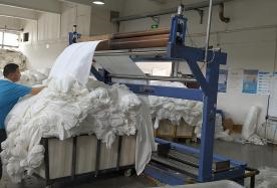
Some suppliers manufacture products directly, while others coordinate production through specialized manufacturing partners.
Distributors should clarify:
- Which company is responsible for manufacturing?
- Where are the products processed and packed?
- Who performs quality inspections?
- Can the supplier maintain the approved specification for repeat orders?
- What documentation is available?
Understanding the actual supply arrangement helps avoid confusion when technical issues or quality claims arise.
Evaluate Communication and Order Management
OEM projects often involve several rounds of sample confirmation, artwork approval and specification adjustments.
A reliable supplier should be able to communicate clearly about:
- Technical feasibility
- MOQ and pricing
- Sample arrangements
- Artwork approval
- Production lead time
- Inspection and shipment arrangements
6. OEM Project Workflow: From Specification to Bulk Order
A clear process can help distributors reduce delays and avoid unnecessary revisions.
<ol> <li><strong>Share your requirements.</strong> Provide the material, GSM, size, edge type, packaging quantity and estimated order volume.</li> <li><strong>Review technical feasibility.</strong> The supplier checks whether the requested configuration can be produced and identifies any limitations.</li> <li><strong>Confirm samples.</strong> Evaluate the sample against your technical and commercial requirements.</li> <li><strong>Approve packaging artwork.</strong> Confirm logos, labels, product descriptions and carton markings.</li> <li><strong>Confirm the quotation and order.</strong> Agree on specifications, MOQ, price, payment terms and delivery arrangements.</li> <li><strong>Inspect before shipment.</strong> Confirm the inspection scope and required documents before dispatch.</li> <li><strong>Maintain the approved specification.</strong> Keep the confirmed sample, TDS and packaging artwork as references for repeat orders.</li> </ol>
For repeat business, distributors should retain an approved specification sheet and sample. This makes it easier to compare future batches and manage product consistency.
7. What Information Should You Include in an OEM Inquiry?
A detailed inquiry helps suppliers provide a more accurate quotation and reduces unnecessary follow-up communication.
Here is a practical RFQ checklist:
| Item | Example Requirement |
|---|---|
| Product | 100% Polyester Cleanroom Wipes |
| Size | 9 × 9 inches |
| Fabric Weight | 140 GSM |
| Edge Type | Laser Cut |
| Color | White |
| Quantity | 100 pcs/bag |
| Packaging | Custom printed inner bag |
| Private Label | Customer logo and product label |
| Estimated Order Quantity | Monthly or quarterly forecast |
| Destination | Country and delivery city |
| Documents | TDS, applicable test reports and other required documents |
If you are not sure about the technical specifications, you can also send a reference sample or existing product datasheet.
The supplier can then review the requirements and suggest a suitable configuration for evaluation.
8. How Honbest Supports Polyester Wipe Sourcing and OEM Projects
Honbest Group supplies cleanroom and ESD consumables to overseas distributors and industrial customers. Its product portfolio includes polyester cleanroom wipes, microfiber wipers, cleanroom paper, gloves, sticky products and ESD-related products.
With nearly 20 years of involvement in the cleanroom wiper industry, Honbest understands the product specifications and sourcing considerations that matter to distributors.
For polyester wipe projects, Honbest can discuss requirements such as:
- Wipe dimensions and fabric weight
- Edge-finishing preferences
- Product specifications and sample evaluation
- Private-label packaging requirements
- Bulk-order planning and shipment coordination
The manufacturing arrangement and customization feasibility should be confirmed for each project. Buyers are encouraged to share their existing product specifications or reference samples so that the requirements can be reviewed before quotation.
Explore the Polyester Cleanroom Wipes product range or visit the Honbest product catalog for more cleanroom consumables.
9. Frequently Asked Questions About OEM Polyester Cleanroom Wipes
Q1: Can I order polyester cleanroom wipes with my own brand?
Yes. Private-label packaging may be available depending on the supplier, product configuration and order quantity. Confirm logo printing, label design and packaging MOQ before placing an order.
Q2: What sizes are available for custom polyester wipes?
Common sizes include 4 × 4, 6 × 6, 9 × 9 and 12 × 12 inches. Other dimensions may be possible after checking the supplier’s production capabilities.
Q3: Can I customize the fabric weight?
Different GSM options may be available. Confirm the available range, tolerance and sample specifications with the supplier.
Q4: Which edge type should I choose?
Cold-cut, laser-cut and ultrasonic-cut options have different processing characteristics and costs. The appropriate choice depends on the application and contamination-control requirements. Ask for samples and relevant test data before making a decision.
Q5: Can the supplier provide particle and ionic contamination test reports?
Some suppliers can provide relevant test reports. The availability of reports depends on the product and testing arrangements. Buyers should confirm the test method, tested sample and report validity.
Q6: What is the MOQ for OEM polyester wipes?
MOQ varies according to wipe size, fabric weight, edge finishing, packaging design and production arrangements. Custom printed packaging may have a separate MOQ from the wipes themselves.
Q7: Should I approve a sample before mass production?
Yes. Sample approval is an important step in OEM sourcing. It helps both parties confirm the product specifications and packaging details before proceeding with a bulk order.
Conclusion
Custom polyester wipes OEM service in China gives distributors the opportunity to develop their own cleanroom product lines with specifications and packaging suited to their markets.
A successful OEM project starts with clear technical requirements. Material construction, GSM, dimensions, edge finishing, cleanliness data and packaging should all be confirmed before mass production.
For distributors looking for a cleanroom consumables sourcing partner, Honbest can discuss polyester wipe requirements alongside other cleanroom and ESD products. Providing a reference sample, existing specification or estimated purchasing volume is a practical first step toward evaluating a suitable solution.
Post time: Nov-05-2026